
Academy / Lessons / Getting the basics right / EP1
Who are your accounts actually for? One set of books, three readers
Bookkeeping is not homework your accountant forces on you. It is the most under-used piece of information in your business — and the same set of books gets read three completely different ways.
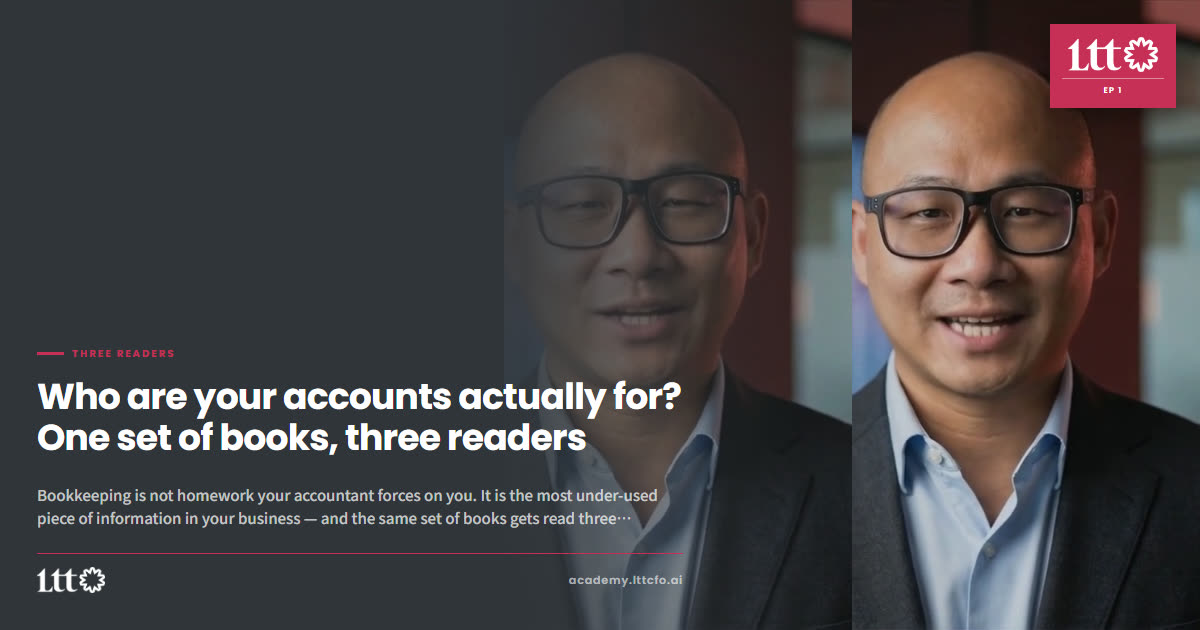
This is the text version of a Mandarin video lesson — watch the original on the 中文 page. The script is written out in full below.
01Key points
- There is only ever one set of books — but three readers: the government, the bank, and you
- The government wants it complete: documents complete, records complete — and in the e-Invoice era a mismatch shows up the moment anyone looks
- The bank wants it credible: it has never been to your shop, it has only ever seen your statements
- You want it clear: the accounts are the boss's dashboard, and driving without one means you only find out on impact
- What messy books cost you: more tax, penalties, a loan turned down, and a business you cannot see
02Text version
Opening
Boss, let me ask you one question: who are your accounts actually for? Most people will say, "Accounts? For tax lah, just to keep the government happy." If that is how you see it too, then every month you are throwing away a genuinely valuable piece of information. Give me three minutes and let us settle one thing: a set of business accounts has three readers.
Let us be clear
First, let us be clear about something. I am not telling you to keep three sets of books. There is only ever one set, and the numbers only have one version. But that same one set gets read by three different people, in three completely different ways.
Reader one · The government
The first reader is the government. This is the one everybody knows: LHDN wants your tax return, SSM wants your annual filing. Now add e-Invoice on top — every invoice you issue is already recorded on their side, so whether your books tie up with it is something they can check in a moment. Messy accounts lead to two outcomes, and both of them cost money. One: an expense you were entitled to deduct has no record and no document, so you cannot claim it and you pay more tax than you needed to. Two: the numbers do not tie up, you get picked for a review, you cannot explain it, and you pay a penalty. Accounts read by the government come down to one word — complete. Documents complete, records complete, dates complete.
Reader two · The bank
The second reader is the bank. Sooner or later a growing business needs working capital or an expansion facility, and that means dealing with a bank. Remember this: the bank has never been to your shop. It has only ever seen your statements. Your business can be doing beautifully, customers queueing out the door — but if the books cannot produce a proper set of financial statements, then as far as the bank is concerned your business is invisible. Whether the loan is approved, how much, at what rate — all of it starts from that one set of statements. Accounts read by the bank come down to one word: credible. Numbers you can trust, sources you can trace, treatment that stays the same year after year.
Reader three · You
The third reader is the most important one, and the one most bosses skip — yourself. Have you ever looked at the bank balance in December and thought, "We seemed to do quite a lot of business this year. So where did the money go?" The accounts are what answer that question. Which product actually makes money? Which customer always pays late? Can you afford one more head? If you open a second outlet, will the cash hold? Making those calls on gut feel is gambling. Making them off the accounts is running a business. The accounts are the boss's dashboard. You can drive without looking at the dashboard — you just find out on impact.
In short
So, in short: one set of books, three readers — the government wants it complete, the bank wants it credible, you want it clear. Get that one set right and the government is satisfied, the bank has confidence, and you know where you stand. Next lesson we take on a more painful subject: company money and your own money, and why the two must never be mixed. I am LTT, helping SME bosses get their accounts straight. Follow us, and do not miss the next one.
03Common questions
Does a small business really need proper accounts?
Yes. In Malaysia, any business income carries a filing obligation — and the smaller the business, the more you need the accounts to show you where the cash actually is.
I keep a running list in Excel. Does that count?
A running list is a starting point, but the bank and LHDN want a complete set of financial statements. Running list → ledger → statements: the work in between is exactly what professional bookkeeping is for.
What changed once e-Invoice came in?
Every invoice you issue is recorded on LHDN's side, so the risk of your books not tying up with the official data goes up sharply. "Complete" moved from being a bonus to being basic self-protection.
Can LTT keep the books for me?
Yes. LTT provides cloud accounting end to end, from sorting the documents to issuing the statements. Write to ltt@lttcfo.com.
Grab a coffee with us and talk about your business — leave the accounts to LTT. Write to ltt@lttcfo.com · WhatsApp 011-1955 5538
04Comments
Verified as at 2026-08-24 · Evergreen lesson — no year-specific tax figures.